
A MongoDB natural language query should end as reviewable Query API syntax. It should not end as "the model seemed confident, so we ran it on production." Describe the documents and ordering you need, ground the request in bounded collection structure, validate the response locally, then put the draft in the normal editor. The model saves typing. The database keeps its adult supervision.
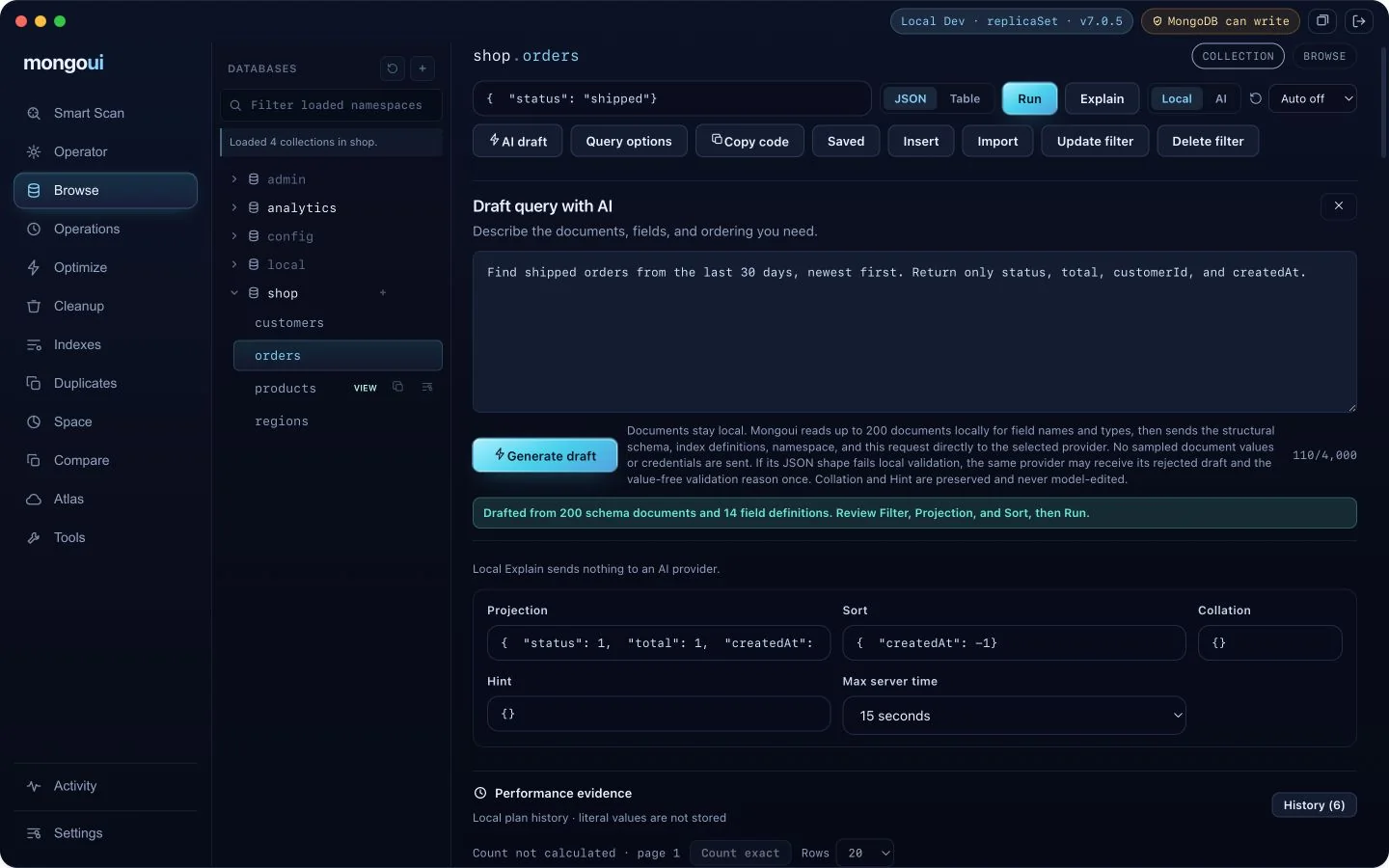
Start with the result, not MongoDB syntax
Write the request the way you would write a precise ticket:
Find shipped orders from the last 30 days, newest first. Return only status,
total, customerId, and createdAt.
A useful find draft separates the concerns:
// filter
{
  status: "shipped",
  createdAt: { $gte: { $date: "2026-06-15T00:00:00.000Z" } }
}

// projection
{ status: 1, total: 1, customerId: 1, createdAt: 1 }

// sort
{ createdAt: -1 }
The exact date should reflect when the request runs, and the editor still needs to preserve MongoDB types. That is why the output is a draft. An ISO-looking string and a BSON Date are not interchangeable just because they dress alike.
For aggregation, describe the full output shape:
For shipped orders in the last 90 days, group revenue by region and month,
then return the highest-revenue months first.
The resulting pipeline might use $match, $group, $sort, and $project. MongoDB's aggregation pipeline documentation remains the source of truth for stage semantics and server-version support.
Structure is enough for most query drafting
A model writes better MongoDB syntax when it knows that createdAt is a Date, customerId is an ObjectId, items is an array, and status is a string. It also needs the namespace and relevant index definitions to avoid inventing fields or suggesting an obviously mismatched sort.
It usually does not need raw customer records.
mongoui reads up to 200 documents locally to infer bounded field names and BSON types. Query and pipeline drafting sends the request, namespace, structural schema, and index definitions directly to the provider you selected. Sampled document values, connection strings, and credentials stay local.
This boundary matters because MongoDB's own Compass natural-language query documentation notes that prompts and schema details are sent to its AI providers. "AI query" is not one privacy behavior. The product has to state the exact payload.
See AI provider setup for the provider, key-storage, and egress rules in mongoui.
Validation belongs between the model and the editor
Model output is untrusted input. Parse it as data, not executable prose. A useful validator should reject:
- unknown top-level fields in the response;
- malformed BSON and invalid stage shapes;
- write stages in a read-only drafting workflow;
- server-side JavaScript;
- limits, projections, or sorts outside the supported contract;
- output that targets a namespace other than the selected one.
mongoui requires a strict JSON response and validates it locally. If the shape fails, the app may send the rejected draft and a value-free validation reason to the same provider once. The correction must pass the same validator. This is not a debate club. Two bad shapes do not average into a valid query.
The generated result then enters Browse or Optimize. It still has not run.
Review the query as if a teammate wrote it
Before execution, check four things.
First, verify types. ObjectId, Date, Decimal128, and 64-bit integers need the intended BSON representation. A query with the right field and wrong type can return nothing while looking perfectly respectable.
Second, verify scope. A missing predicate can turn "recent shipped orders" into the entire collection. Use the normal limit and server-time controls while checking the draft.
Third, verify projection and sort. Keep _id visible when you plan to edit results. Make sure ordering matches the business request, not just the first index the model noticed.
Fourth, measure. Run explain() when the result could scan meaningful data. The MongoDB find documentation defines the query behavior; the execution plan tells you what this collection will actually pay for it.
The natural-language query guide walks through the exact product controls.
Keep query generation separate from database operation
One draft is the right abstraction when the user already knows the desired result. A broader request may require inspection before the next action is knowable:
Find why this orders collection is slow and prepare the safest index change.
That task needs schema and index inspection, a measured explain plan, and perhaps one final recommendation based on the evidence. It should not be squeezed into one giant generated pipeline.
The AI Database Operator handles this as typed plan cards. Reads need approval. Previewable writes need fresh measured evidence. Final writes need a separate apply action. Read-only connections remove write tools from the catalog below the renderer.
Use query drafting for one find or aggregation. Use Operator when the answer depends on measured intermediate results.
Natural language does not remove database judgment
AI is good at syntax assembly, especially when the request is precise and the schema is real. It is not authoritative about business meaning, acceptable blast radius, or whether a query belongs on the primary at peak traffic.
The practical workflow is short:
- Describe the exact result.
- Generate against bounded structure.
- Validate locally.
- Review BSON, scope, and semantics.
- Run with limits.
- Explain before optimizing.
- Save only the reviewed result.
That is a useful MongoDB AI query generator. Anything shorter is autocomplete with a production credential.
mongoui is free for macOS and Windows. The feature overview covers queries, guarded writes, diagnostics, and environment comparison, and the download page reads the current signed and unsigned platform status from the public release feed.